 by Nikola Vejin

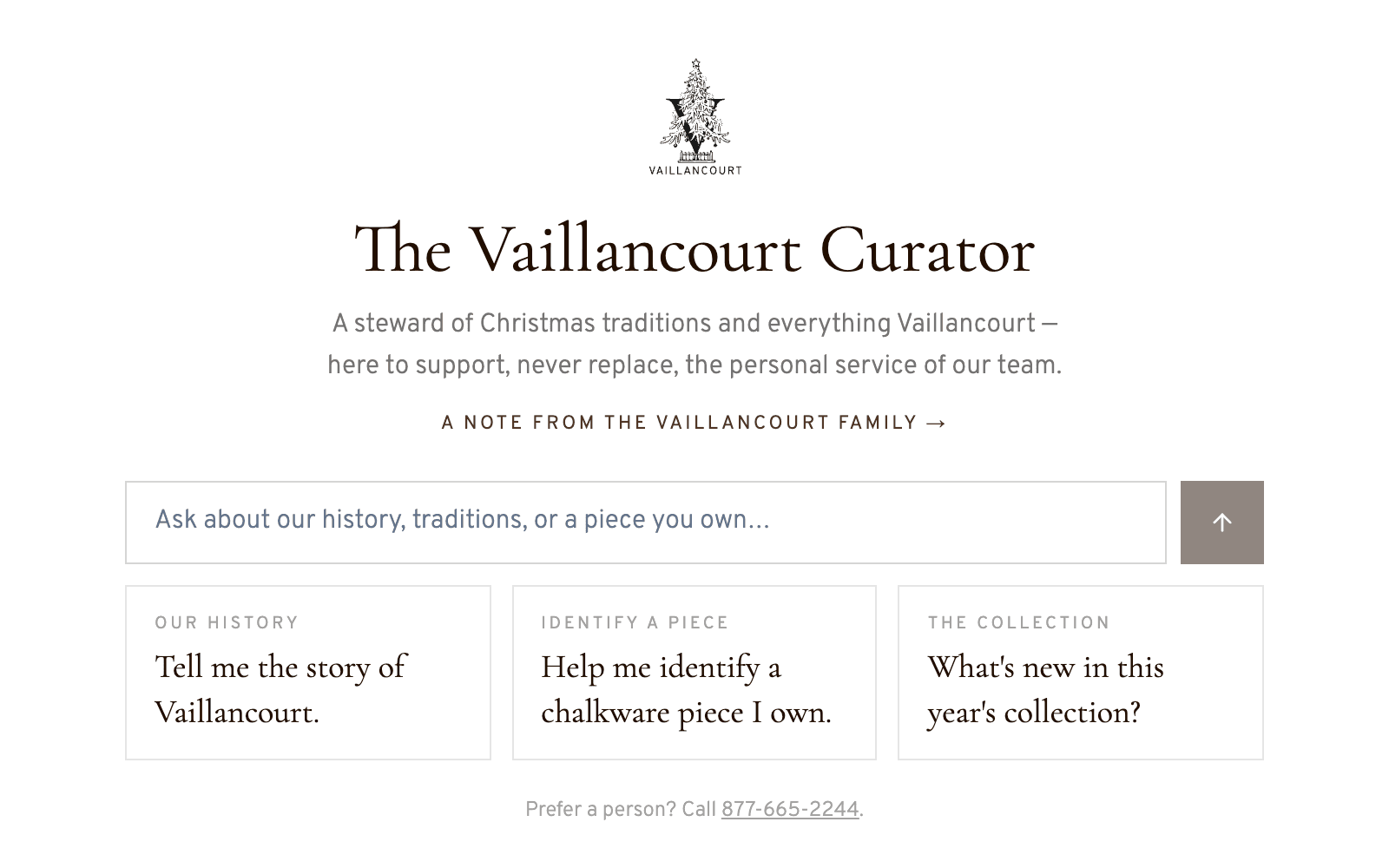
Vaillancourt Christmas Curator
Vaillancourt Folk Art is a family-run American maker of handcrafted chalkware collectibles, best known for its Santas. I built the Vaillancourt Christmas Curator for them: an AI agent on their site that answers collectors' questions straight from the live store and the family's own archives. Ask what year a piece was made, what else came out of the same mould, or what's on at the gallery this weekend, and the answer comes from the real data, with the actual pieces right there in the conversation. It's live on valfa.com today.
The brief from Luke, the company's president, was a fun one: instead of another chatbot answering support questions, he wanted a museum curator for Christmas.
Why it mattered
Vaillancourt has been making collectible chalkware since 1984, and after four decades the catalog runs deep: thousands of pieces, many long retired, each with its own year, mould and story. Collectors write in with questions that take deep knowledge to answer. What do I own, when was it made, what would go with it. That knowledge lived with a handful of people at the company, and they can only answer so many questions in a day. The family wanted collectors to be able to research any time of day, in a way that supports the personal service they're known for instead of replacing it. And it had to get the facts right, because collectors notice when you don't.
Experience goals
- It acts like a curator. It greets you as a steward of Christmas traditions and everything Vaillancourt, and the whole experience is built around researching, identifying and discovering rather than filing tickets.
- Answers from Vaillancourt's world only. Everything the Curator says comes from the company's own store, archives and calendar, so it stays out of internet guesswork.
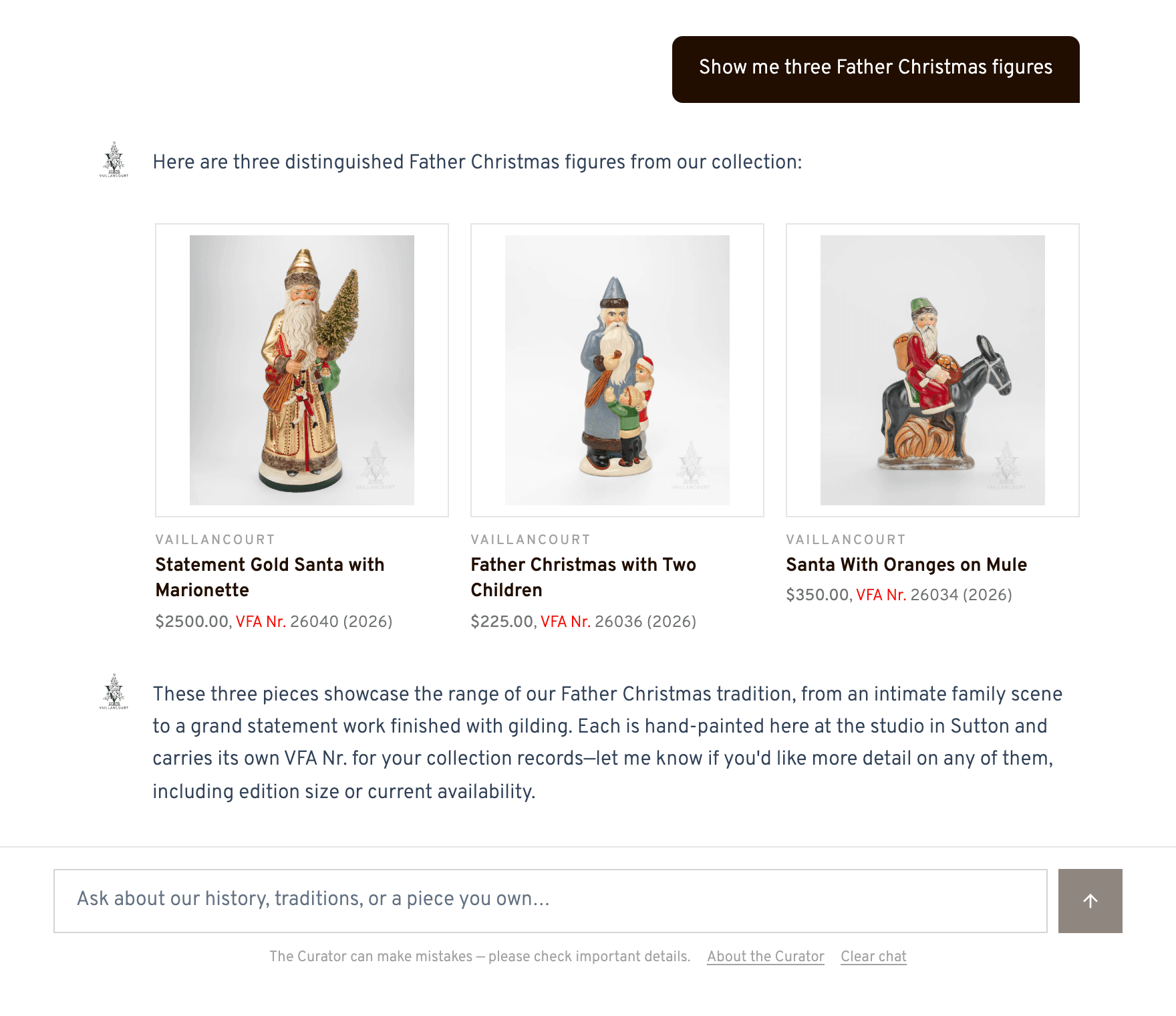
- Real pieces right inside the conversation. Ask for a recommendation and you get actual pieces with photos and prices, presented the way the rest of the site presents them.
- It knows when to hand you to a human. For anything it can't answer with confidence, it points you to the family's Collector Services team instead of improvising.
- At home on the brand's site. Same typography and tone as the rest of valfa.com, so it feels like it has always been part of the site.
What the app delivers
- Answers about the company, the family and the Christmas traditions behind the art, from Vaillancourt's own material.
- Finds pieces in the live store by name or theme, by VFA number or mould number, or by the year they were issued, and shows them as cards with photo, price and VFA number, laid out like the rest of the site.
- Suggests related pieces that actually belong together: other versions from the same mould first, then the pairings the family set up in the store.
- Honest about availability. When you ask, the Curator checks the live store, and it still suggests a quick call to the Retail Gallery to confirm, since quantities change fast.
- What's on at the gallery. Questions about upcoming events are answered from valfa.com's own calendar, with real dates, times and links.
- A conversation that streams as it's written and remembers what you've already said, so a collector can keep refining what they're looking for.
- Escalation to the Collector Services team when a question deserves a person.
- Built into valfa.com, so it runs as a normal part of the site.
Challenges
- Product facts had to be exactly right. The first version worked from a spreadsheet of the catalog that we exported and uploaded by hand. Collectors liked it and the history answers were good, but every so often it got a price wrong or described a photo that didn't exist, and the export went stale between uploads. So in the 2026 rebuild the model holds no product data at all. When a question is about a piece, its job is to pick the right lookup, the store answers, and the cards are drawn from that answer, so the price and photo on a card are always the store's own.
- Recommendations people can trust. The rules for what to show and in what order used to be instructions in a prompt, and the model followed them most of the time. Now they're code: newest pieces first, Vaillancourt's own work ahead of other brands, in stock ahead of sold out, and related pieces by mould first. They run the same way every time.
- Keeping it safe. The agent can only call a handful of read-only lookups I wrote, so what it can reach is decided by code. Conversations stay in the visitor's browser and clear after a week, there's a limit on how fast anyone can send messages, and a monthly spending cap keeps the bill predictable.
- Events had no feed with real dates. The site's calendar only published titles and publish dates, so I added a small endpoint to the WordPress site that shares upcoming events with their dates and times. A new event shows up in the Curator's answers within about twenty minutes, with nothing to update by hand.
- Hiding the machinery. Early versions would mention their own source documents mid-answer, which ruins the whole curator feel, so I kept working on it until those slips were gone.
- Evolving it with the client. Luke had opinions, good ones, all through development, and the product got better in short cycles of feedback and shipping rather than one big reveal.
How I approached it
The Curator is a Next.js app, React and TypeScript with Tailwind for the interface. In 2026 I rebuilt it as an AI agent on the Vercel AI SDK, connected straight to the live valfa.com store and calendar, with the history and traditions coming from the family's own material: the company book, the Wikipedia article and the notes Luke wrote for it. The model runs through Vercel's AI Gateway, so switching to a better one is a single setting rather than a rebuild. I ran Claude and GPT side by side on the same questions. Both got the facts right, and Claude wrote warmer and closer to how the family talks, so it's the default. To keep it that way, a test set of 29 typical collector questions runs whenever the Curator or the model changes, and eleven separate checks cover the sorting, recommendation and calendar rules on their own, with no AI involved. We worked in short iterations: Luke would try it, tell me where it fell short of the curator he had in mind, and I'd ship the improvements while the feedback was still fresh.
Outcome
The Christmas Curator is live on valfa.com, introduced by the family with a promise I like: it exists to support the personalized service collectors have trusted for four decades, never to replace it. Collectors can research the collection, their own pieces and the traditions behind them at any hour, with prices, photos and availability that match the store because they come from it. A conversation costs a few cents, and the people at Vaillancourt keep their time for the conversations that really need them.
We hope that this use of AI will set a standard in how the delicate curation of traditions and beliefs can help preserve the spirit of Christmas, which aligns with Vaillancourt Folk Art's core mission.


